
It’s still called liquid gold. Now we know why.
At Olympia, the victor’s crown was a wreath cut from a wild olive tree. At the Panathenaic Games in Athens, winners were given amphorae of oil from the sacred trees of Athena, large painted jars of oil of great value that a champion could keep or sell. No gold, no silver. Of everything they could have chosen, they chose oil and a branch.
The Greeks even had a name for oil pressed from green, unripe olives: omphakion. The physician Dioscorides called it the best for medicine, and later farming writers advised picking olives while still green and storing the oil cool and dry. We’d call it early harvest. In Greek, agourelaio. Green olives give less oil but carry more phenolic compounds, and now we can measure them.
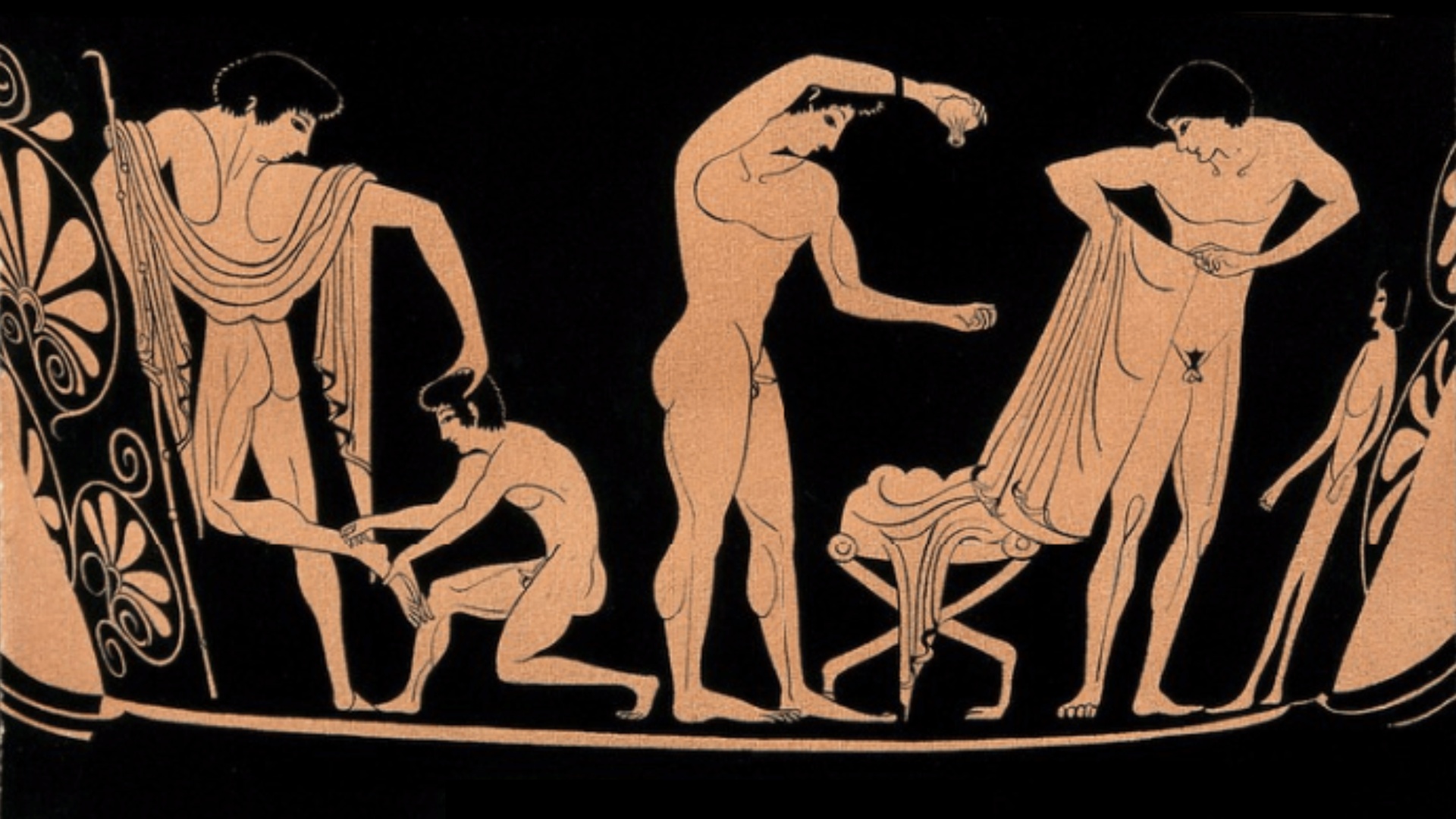
Olive oil was not only a prize. Athletes anointed their bodies with it before they trained, and afterward scraped off the oil, sweat and dust together with a curved bronze tool called a strigil. Soldiers carried it in their kit with barley meal. It was food, fuel, skin care and ritual at once.
The Greeks also paid close attention to digestion. Their word diaita meant a whole way of living, and food was at the center of it. They favored what the body could take in easily and let go of easily, and they understood that a body that digests well has strength, energy and a clear head. They had no microscope, and they got the principle right anyway.
What they couldn’t see is what happens next. Only about 5–10% of the phenolic compounds in a good oil are absorbed in the small intestine. The rest reach the colon, where gut bacteria transform them into smaller metabolites that the body absorbs better. Reviews of the research report that these compounds enhance beneficial bacteria such as Lactobacillus and Bifidobacterium, and promote short-chain fatty acids.
I want to be honest about where this stands. The studies are short, the oils vary, the methods aren’t standardized, and there are few human trials, which makes causality hard to establish. One small trial had ten participants take 25 mL a day for three weeks of oils with different phenolic content, from about 80 mg/kg up to 500 mg/kg. That is early science, and I’m not claiming more. But the direction is clear, and it points to one thing: the phenolic content is the part worth measuring.
That is why Aristoleo exists. We began studying and testing high phenolic extra virgin olive oil in 2012. In 2015 we incorporated Aristoleo, in 2016 at Ancient Olympia we introduced our Awards and education, and in 2020 announced the Aristoleo cooler. In 2023 we began certifying. In 2026, we registered Aristoleo as a Canadian Federal NPO.
Certification rests on three criteria: third-party verified phenolic content, using qNMR; independent third-party laboratory analysis for defects; and CoolChain™ compliance, which keeps the oil at 12.5–15°C through production, shipping and storage. The first two are established through the Aristoleo Awards with new oils submitted every harvest.
We do it because active biophenols can degrade by as much as 50% within twelve months if heat, light, air and time are left to do their work. Much of the oil on the shelf was never protected. Aristoleo Certification is a wellness designation, not a culinary one. It tells you what is actually in the bottle, so you aren’t guessing.
If you’re choosing an oil, I suggest 500 mg/kg. Even after cooking, you stay above the 250 mg/kg threshold the EU health claim rests on.
The Greeks gave their champions oil because they knew it mattered. We can now begin to see why, and we can measure it. I’d like you to know what is in yours.
Image Credit: Scene in a gymnasium, from an Attic krater attributed to Euphronios, late 6th century BC (Berlin Museum 2180).

